EigenDA Protocol Contracts
This page describes EigenDA contracts that are managed by EigenDA related actors (see the exact roles).
Warning: This page is incomplete and a work in progress as we are undergoing refactors of our contracts as well as some protocol upgrades. The details will change, but the information contained here should at least help to understand the important concepts.
Overview
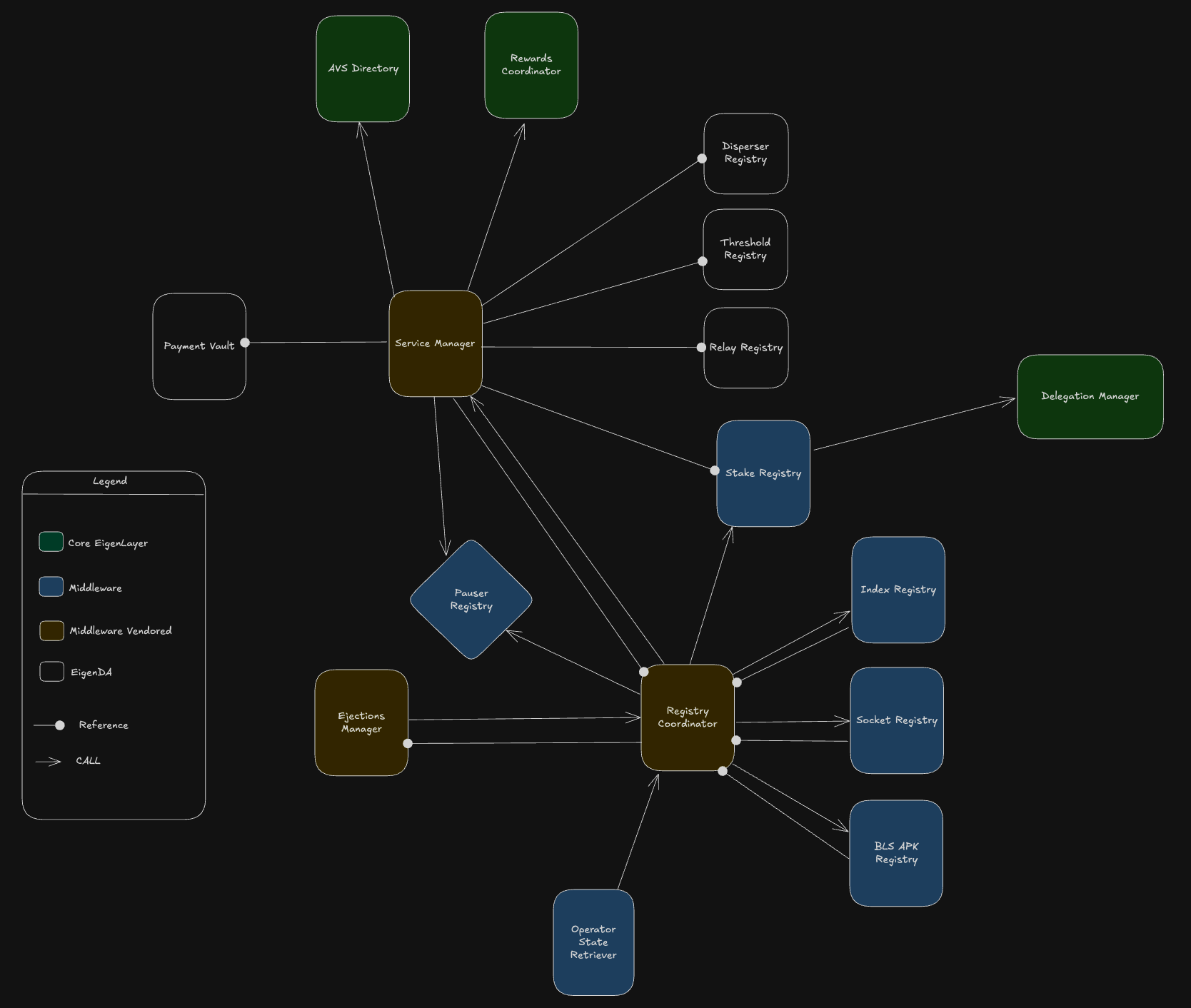
Middleware Contracts
We make use of eigenlayer-middleware contracts, which are fully documented here and described here. These contracts provide standard interfacing logic for operator state management and AVS representation.
Middleware Vendored Contracts
Some of the middleware contracts (e.g, EjectionsManager, RegistryCoordinator) have been directly vendored into the EigenDA project with minor modifications made.
EigenDA Specific Contracts
The smart contracts can be found in our repo, and the deployment addresses on different chains can be found in the Networks section of our docs.
Integration Contracts
For EigenDA-related contracts that are managed by rollups, see the rollup managed contracts page.
The EigenDA team maintains one customer-facing contract, EigenDACertVerifier. However, using this contract directly is not recommended. The EigenDACertVerifier includes a certVersion parameter that, if upgraded without corresponding updates to a rollup’s offchain code, can lead to liveness outages. Relying on this contract places a rollup’s safety and liveness on EigenDA governance, which is generally discouraged.
Contracts Overview
| Contract Name | Project Category | Deployed Behind ERC1967 Proxy? | Used by Offchain EigenDA Protocol? |
|---|---|---|---|
| EigenDA Directory | eigenda | Yes | Yes |
| Service Manager | eigenda | Yes | Yes |
| Threshold Registry | eigenda | Yes | Yes |
| Relay Registry | eigenda | Yes | Yes |
| Disperser Registry | eigenda | Yes | Yes |
| Payment Vault | eigenda | Yes | Yes |
| Pauser Registry | middleware | No | No |
| BLS APK Registry | middleware | Yes | Yes |
| Index Registry | middleware | Yes | Yes |
| Stake Registry | middleware | Yes | Yes |
| Socket Registry | middleware | Yes | Yes |
| Operator State Retriever | middleware | No | Yes |
| Registry Coordinator | vendored middleware | Yes | Yes |
| Ejections Manager | vendored middleware | Yes | No |
| Cert Verifier Router | integrations | Yes | No |
EigenDADirectory
Description
This contract serves as the central discovery and reference point for all contracts composing the EigenDA system. It implements a lightweight namespace resolution protocol in which human-readable string keys are mapped to EigenDA contract addresses.
Access Mgmt
Ownablerole that can do unilateral entry key modifications
Offchain Usage
This dynamic naming pattern requires off-chain management of canonical contract keys, allowing clients and services to retrieve on-chain system context from a single directory contract reference rather than requiring every contract address to be hard-coded or passed through environment configuration.
EigenDAServiceManager
Description Used for onchain AVS registration with the EigenLayer protocol, EigenDA V1 batching, storing protocol params, rewards distribution, and referencing EigenDA protocol contracts:
- Inherits the
ServiceManagerBasefor operator registration and rewards distribution. - Manages batch settlement roles with callable function (i.e,
confirmBatch) that allows for EigenDA V1 batches to be confirmed and settled into a storage commitment sequence. - Stores protocol params (i.e,
BLOCK_STALE_MEASURE,BLOCK_STORE_DURATION) for offchain ingestion by DA validator nodes. - Stores non-callable references to other EigenDA protocol contracts in storage (i.e,
DisperserRegistry,ThresholdRegistry,RelayRegistry,StakeRegistry,PaymentVault).
Access Mgmt
Pauserrole that can halt EigenDA V1 batch settlementOwnablerole that can modify batch confirmer EOA allow-list, AVS metadata,RewardsClaimee, andRewardsInitiatorRegistryCoordinatorrole that can register/de-register operators through routed calls to theAVSDirectory(i.e,RegistryCoordinator->EigenDAServiceManager->AVSDirectory)RewardsInitiatorrole that can create operator directed and general AVS rewards via routed calls to theRewardsCoordinatorcontract (i.e,RewardsInitiator->EigenDAServiceManager->RewardsCoordinator)
Offchain Usage
TODO
EigenDAThresholdRegistry
Description
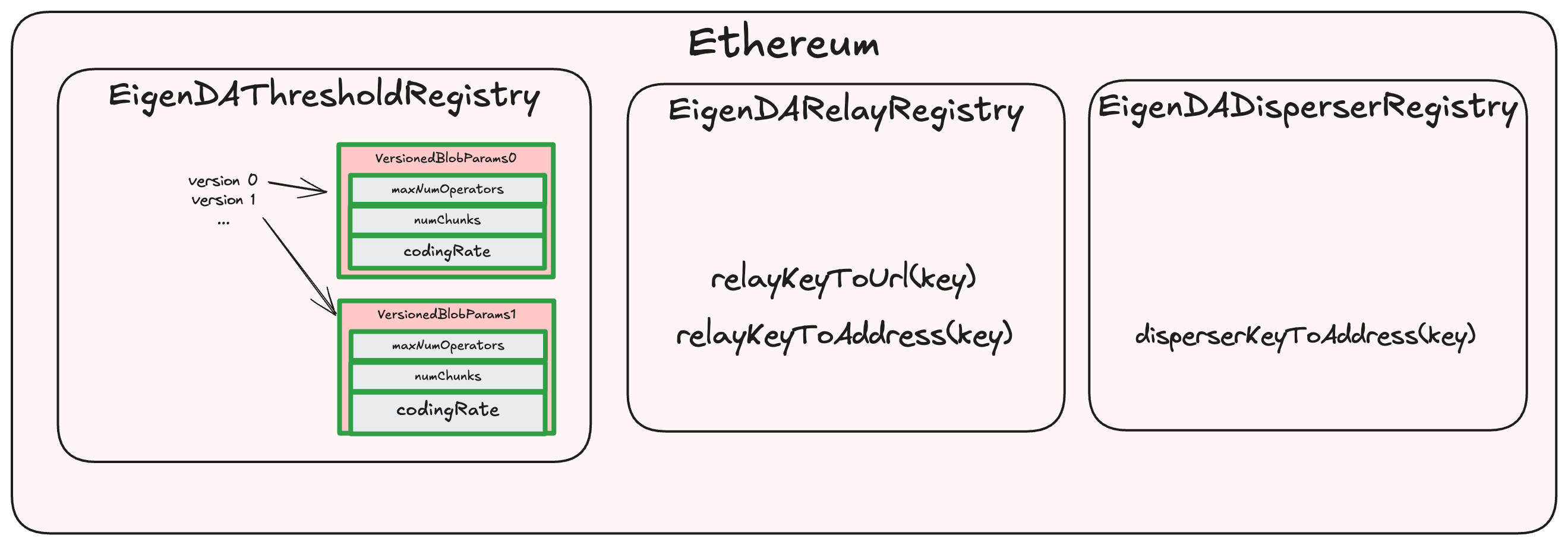
The EigenDAThresholdRegistry contains two sets of protocol parameters:
/// @notice mapping of blob version id to the params of the blob version
mapping(uint16 => VersionedBlobParams) public versionedBlobParams;
struct VersionedBlobParams {
    uint32 maxNumOperators;
    uint32 numChunks;
    uint8 codingRate;
}

/// @notice Immutable security thresholds for quorums
SecurityThresholds public defaultSecurityThresholdsV2;
struct SecurityThresholds {
    uint8 confirmationThreshold;
    uint8 adversaryThreshold;
}
The securityThresholds are currently immutable. Confirmation and adversary thresholds are sometimes also referred to as liveness and safety thresholds:
- Confirmation Threshold (aka liveness threshold): minimum percentage of stake which an attacker must control in order to mount a liveness attack on the system.
- Adversary Threshold (aka safety threshold): total percentage of stake which an attacker must control in order to mount a first-order safety attack on the system.
Their default values are currently set as:
defaultSecurityThresholdsV2 = {
    confirmationThreshold = 55,
    adversaryThreshold = 33,
}
A new BlobParam version is rarely introduced by the EigenDA Foundation Governance. When dispersing a blob, rollups explicitly specify the version they wish to use. Currently, only version 0 is defined, with the following parameters (reference):
versionedBlobParams[0] = {
    maxNumOperators =  3537,
    numChunks = 8192,
    codingRate = 8,
}
The five parameters are intricately related by this formula which is also verified onchain by the verifyBlobSecurityParams function:
where
EigenDARelayRegistry
Description
Contains EigenDA network registered Relays' Ethereum address and DNS hostname or IP address. BlobCertificates contain relayKeys, which can be transformed into that relay's URL by calling relayKeyToUrl.
Access Mgmt
Ownablerole that can register new relay entries
Offchain Usage
TODO
EigenDADisperserRegistry
Description
Contains EigenDA network registered Dispersers' Ethereum address. The EigenDA Network currently only supports a single Disperser, hosted by EigenLabs. The Disperser's URL is currently static and unchanging, and can be found on our docs site in the Networks section.
Access Mgmt
Ownablerole that can register new dispersers
Offchain Usage
TODO
PaymentVault
Description
Payment contract used to escrow on-demand funds, hold user reservations, and define global payment parameters used by the network (i.e, globalSymbolsPerPeriod, reservationPeriodInterval, globalRatePeriodInterval).
Access Mgmt
Ownablerole that can set payment reservations
Offchain Usage
TODO
PauserRegistry
Description Manages a stateful mapping of pausers that can be arbitrarily added or revoked. This contract is assumed to be deployed immutably. The pauser mapping is checked by caller:
- Mapping checked as prerequisite for pausing batch confirmation logic in
EigenDAServiceManager - Mapping checked as prerequisite for pausing operator state update logic in
RegistryCoordinator
Access Mgmt
Unpauser(or admin) role that can set / remove existing pausers
Offchain Usage
TODO
BLSApkRegistry
Description
This contract stores each operator's BLS public key as well as per quorum aggregate public keys which are only updatable by the RegistryCoordinator.
Access Mgmt
RegistryCoordinatorrole that can invoke aggregate key updates via the registration/de-registration of operators
Offchain Usage
TODO
IndexRegistry
Description Maintains an ordered, historically versioned list of operators for each quorum, allowing the RegistryCoordinator to register or deregister operators while preserving full block-by-block history of operator counts and index assignments. It provides efficient read functions to reconstruct the operator set at any block.
Access Mgmt
RegistryCoordinatorrole that makes stateful updates when registering / deregistering quorum operators
Offchain Usage
TODO
StakeRegistry
Description Stores stake updates bounded by block number and quorum strategy:
    struct StakeUpdate {
        // the block number at which the stake amounts were updated and stored
        uint32 updateBlockNumber;
        // the block number at which the *next update* occurred.
        /// @notice This entry has the value **0** until another update takes place.
        uint32 nextUpdateBlockNumber;
        // stake weight for the quorum
        uint96 stake;
    }
Access Mgmt
Ownablerole that can deploy and modify staking strategiesRegistryCoordinatorrole that makes stateful updates when registering / deregistering quorum operators
Offchain Usage
TODO
SocketRegistry
Description
Stores stateful mapping of operator ID => socket where socket is the operator's DNS hostname.
Access Mgmt
RegistryCoordinatorrole that makes stateful updates when registering / deregistering quorum operators
Offchain Usage
TODO
OperatorStateRetriever
Description
A stateless read-only contract that does exhaustive lookups against the registry coordinator for fetching operator metadata. This bundles stored procedure logic to avoid exhaustive RPC calls made to view functions by offchain EigenDA services.
Access Mgmt
N/A
Offchain Usage
TODO
EigenDARegistryCoordinator
Description
This contract orchestrates operator lifecycle across EigenDA's stake, BLS key, index, and socket registries - handling:
- registration, deregistration
- churning
- stake-updates
- quorum creation/config
- historical quorum-bitmap tracking
Access Mgmt
Pauserrole that can halt operator state updatesOwnablerole that can add new quorums, operator set params, & ejector params / role changesEjectorrole that can invoke an ejection function to forcibly deregister an operator
Offchain Usage
TODO
EigenDAEjectionsManager
Description
Coordinates the lifecycle of ejecting non-responsive operators from EigenDA. It allows an Ejector role to queue and complete ejections. Each queued ejection has a corresponding bond attached by the Ejector where a targeted operator can cancel the ejection by providing a signature before it becomes "confirmable" after a number of DelayBlocks.
Access Mgmt
Ownablerole that can change public parameters (i.e,DelayBlocks,CooldownBlocks)Ejectorrole that can invoke an ejection function to forcibly deregister an operator
Offchain Usage
TODO
CertVerifierRouter
Description
See here.
Access Mgmt
Ownablerole that can add newEigenDACertVerifierentries at new activation block number
Offchain Usage
This dynamic naming pattern requires off-chain management of canonical contract keys, allowing clients and services to retrieve on-chain system context from a single directory contract reference rather than requiring every contract address to be hard-coded or passed through environment configuration.
Governance Roles
There are four key governance roles in the EigenDA contracts seen across network environments (i.e, mainnet, hoodi-testnet, hoodi-preprod, sepolia-testnet):
- ERC1967
ProxyAdminthat can upgrade implementation contracts Ownerthat can perform sensitive stateful operations across protocol contractsPauserthat can halt stateful updates on theServiceManagerandRegistryCoordinatorcontracts. This role is managed by the immutablePauserRegistrycontractEjectorthat can initialize and complete ejection requests via theEjectionsManagercontract